

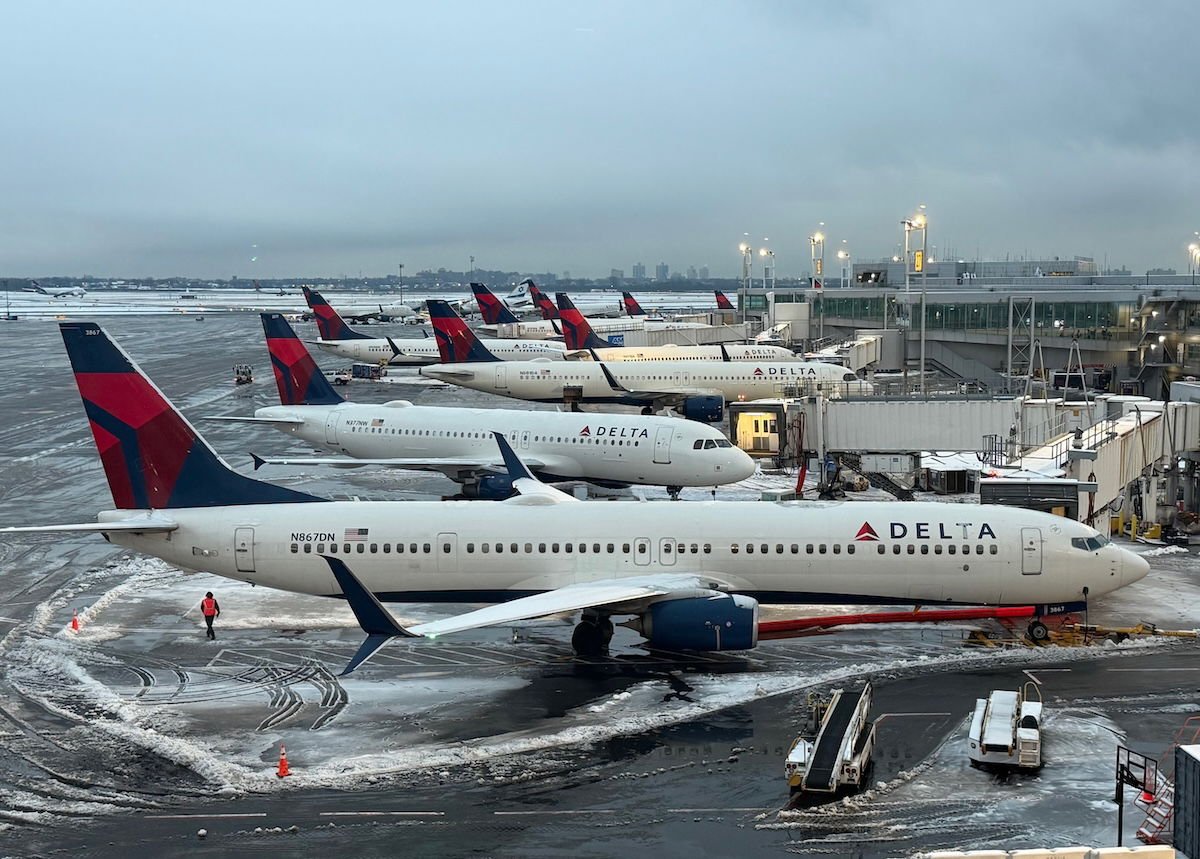
Delta Air Lines ordinarily prides itself in its operational reliability (“the on-time machine”), and beating its peers in terms of on-time percentage and completion factor. However, every so often the airline has a bit of a meltdown, which shows that the airline also has some vulnerabilities.
While I wouldn’t call it a “meltdown,” Delta has had a very rough several days, and the root cause of this is fascinating.
Delta lagged peers with Northeast storm recovery
Over the weekend, we saw a winter storm hit the Northeast, which obviously impacted airline operations. As you’d expect, very bad weather can slow things down, and given the complexity of airline scheduling, this can cause a domino effect throughout the network.
There’s simply no denying (well, maybe I shouldn’t say that) that Delta trailed its peers when it came to recovery from the snowstorm, and the carrier’s number of cancelations and delays reflects that:
- On Saturday, December 27, 2025, Delta canceled 7% of its flights and delayed 39% of its flights
- On Sunday, December 28, 2025, Delta canceled 9% of its flights and delayed 34% of its flights
- On Monday, December 29, 2025, Delta canceled 4% of its flights and delayed 35% of its flights
JonNYC has the data on just how bad Delta did operationally, compared to peers at select airports (since obviously the above doesn’t tell the full story). While the initial operational issues can of course be blamed on the weather, the real issue is how long it took Delta to recover from operational issues. JonNYC shared a quote from an insider about how “you have no clue how f***** Delta’s pilot coverage system is.”
What was particularly telling is how cancelations were being coded in Delta’s system as “Flight Operations-Crew Uncovered- Normal Ops.” The key detail here is that flights were being canceled due to lack of crew (rather than any other factor, like weather), and the airline was having these issues under “normal operations” rather than under “irregular operations.”
Why did Delta have issues with scheduling pilots?
The above raises the question of what kind of a screw up Delta had with its pilot scheduling that caused the airline to recover so slowly? Did the software break? Were there simply not enough pilots? How was this an issue at Delta, but not at other airlines?
Well, we now have a fascinating explanation, though it’s kind of wild. FlyerTalk member jjglaze77 shares an incredibly detailed explanation of how this happened, which I’m inclined to believe (thanks to AJ for flagging this):
The issue is with the ongoing back and forth with the pilot group. Basically, both the pilots and the company are exercising contractual loopholes that have crippled the company’s ability to staff trips that become open with less than 18 hours to departure.
Ironically, it started when the company introduced some new software to try and improve the situation. Several years back, the company introduced a 3rd party crew staffing app (ARCOS) to help automate some crew scheduling processes. Prior to this software, the last minute overtime coverage (“Green Slips” / double pay) was done manually by a crew scheduler and if they got the pilot on the phone, the trip was theirs. With this software, the company could contact pilots in groups (“batch sizes”) instead of 1 at a time. This created situations where pilots would be woken in the middle of the night to acknowledge a trip that they in fact would not be given because 10 pilots had been called, but only the senior pilot who acknowledges gets the trip. So, they negotiated an option to “auto-accept” a trip which would then give them a 12 minute window to contact the company and acknowledge the trip. Eventually the company decided that they didn’t want batch sizes and ALPA essentially gave away batch size limits for free (a controversial move). Now that the company could call everyone at once, this created more nuisance calls in the night which drove up the use of the auto-accept feature. More recently, they negotiated to also have this same app be used for normal last minute pickups (“White Slips” / standard pay).
Because of the increase in auto-accept and reduced staffing in crew scheduling, the company found they were having trouble staffing flights. So, they turned to a previously obscure and little used function in the contract called 23M7 which allows them to skip all of the coverage steps (the app) and simply award a trip to anyone they can get on the phone (“Inverse Assignment”). In order to do this, they pay the pilot who flies the trip 2x pay and then they have to identify a “harmed” pilot who was skipped over (since they skipped the app) and pay them 1x pay. It costs Delta 3x to staff trips this way, but it eliminates all the steps that are normally followed – making it much easier for a crew scheduler to get the trip covered. The proliferation of this method of staffing has created an even greater use of the “auto-accept” feature of the app because a pilot has to have this feature turned on in order to potentially become the 23M7 “harmed pilot” and get 1x pay without having to fly.
So, let’s say a trip needs a new captain 12 hours before departure. They will begin to ask pilots through the app if they want the trip, but imagine in a large base (ATL 320) that 200 pilots have “auto-accept” turned on. That means that each of them has 12 minutes successively to acknowledge the trip. As you can see, the math doesn’t math and they then have to go into the emergency coverage step / 23M7. All of that is a manual process though and they have staffed the department at a level that expected / anticipated automation.
Weather may be the initial cause of why a flight needs new pilots, but make no mistake – the reason they are cancelling like this is because of this contractual catch-22 they find themselves in. There is of course a great amount of finger pointing behind the scenes about who’s fault it is – good arguments on both sides.
The above is of course super nuanced, but wow, that’s… quite something. Talk about an overly complex and costly system. So to simplify this as much as possible, for those who have no clue what’s going on:
- Delta has software that automatically reassigns trip, and then each pilot can sign up to auto accept trips, giving them 12 minutes to confirm or reject a trip; when you consider the size of some bases, there are hundreds of pilots you’re potentially cycling through, so that is an issue
- Because of how complex this system is, Delta then has to manually go in and assign trips, because only “showing” the trip to five pilots per hour makes it really hard to staff flights at the last minute
- The wild part is that this is basically an arbitrage opportunity for pilots, since they have an incentive to auto accept trips and draw things out as much as possible, so that the airline ends up having to triple pay for staffing, in order to bypass this (double pay for the person who works the trip, and single pay for the person who accepts the trip, but then has the trip taken away)
I understand crew scheduling software is incredibly complex, and labor contracts can be complicated. But my gosh, from an outsider’s perspective, that system seems totally bizarre, no?
Bottom line
A storm hit the Northeast over the weekend, which impacted airline operations. While all airlines were initially impacted, Delta took longer to recover than its major peers, which is concerning for the airline that prides itself in reliability.
We knew that Delta’s slow recovery came down to issues with assigning trips to pilots, though we didn’t fully realize what the root cause of this was. We know have an explanation, and it basically seems that Delta’s system for reassigning trips for pilots is highly inefficient, and also ends up being very costly for the airline.
What do you make of Delta’s pilot scheduling software, and how it slowed the carrier’s recovery?